Honeymoon beers, part 10: Mystery beer

I saved the best beer of the trip for the last post. The thing is, I can’t tell you about it.

See, I made a deal with the person who offered me the beer. I would only get to drink it on two strict conditions:

1) That I not publish online what it was or where I drank it.

2) That I name my price, no questions asked.

I couldn’t have agreed to the deal any faster. The beer sounded top-notch, and it more than lived up to my stratospheric expectations. I can safely say that it’s one of the top 5 beers I’ve ever had, and I was really sad to see the bottom of the glass.

Trust me, I’m dying to write all about it. I even took full tasting notes.

But I have to hold up my end of the bargain. So this is the last I’ll say about it online. I’ll be more than happy to share details about it offline, though.

On that note, it’s time to wrap up this multi-part trip recap. Thanks for reading. Big thanks, again, to everyone who shared tips and advice before and during the trip, especially all the nerds on BeerAdvocate. And an extra special thanks to Mrs. Beernerds for letting me indulge my love of beer throughout the trip. She’s obviously a keeper.

One last thing: I’ve got the notes and the Google Maps I put together to guide my beer hunting in Bruges, Brussels, Amsterdam and Paris. If you’re headed that way, let me know and I’ll be happy to share them with you. Leave a comment on this post, or e-mail me: beernerds at gmail dot com.

Honeymoon beers, part 9: Normandy, Paris, Au Trappiste, Frog & Princess

With five days in Paris giving us plenty of time, we took a day-trip to Normandy for what turned out to be a great tour of the D-Day landing areas. We had lunch at the café in the Reine Mathilde hotel in Bayeux, the town nearest Omaha Beach and the meeting place for our tour.

The restaurant didn’t have much to offer beer-wise, aside from two offerings from Pelforth, a brune and a spring seasonal. I had never heard of the brewery, but I figured it was worth a shot and ordered the Brune. It was pretty decent, sweeter and less complex than the best of the style — it seemed like more of an English brown than a Belgian brune – but still a good beer.

Pelforth Brune

Back in Paris the following day, we had a post-Louvre lunch at a restaurant/bar nearby, Au Trappiste. As its name implies, the place is Belgian-beer friendly. I started with La Trappe Quadrupel, another classic quad. I was happy to be able to drink one, even a fresh one, after the disappointment in Amsterdam.

La Trappe Quadrupel

I didn’t plan on a second beer, but near the end of the meal I noticed a chalkboard advertising their beer of the month, St. Feuillien Biere de Paques (the second Easter beer I had on the trip). I’ve enjoyed the couple of St. Feuillien beers I’ve tasted, so I didn’t hesitate to try their seasonal. It was quite good — bigger, darker, bolder and boozier than I expected for a spring beer (with lighter, refreshing brews such as St. Arnold Spring Bock in mind), but I enjoyed it.

St. Feuillien Biere de Paques

Our last night in Paris (and in Europe), we went back to one of my old haunts, The Frog & Princess, a lively brewpub in the 6th. Even though I wasn’t into craft beer yet, I hung out here a lot when I lived in Paris in 2002. I loved one of their dark beers (back when my favorite beers were Bass and Guinness), and it was a great spot to watch US sports on satellite TV (including NFL and MLB).

When we walked in this time, it looked completely empty, so much so that we weren’t sure they were open. Once we got inside, we noticed two people drinking at the bar, and two bartenders. There were 6 taps and one hand-pulled engine, and I asked the bartender about the latter, in French. We quickly figured out he was from the US (Philly, to be exact), so I asked him about the rest of the lineup in English. He gave me a sample of a couple of beers, before deciding to save us the trouble and giving me a full sampler (and not charging for it).

The 6 beers were:

-FNB (Frog Natural Blonde)

-Maison Blanche

-Ginger Twist

-Parislytic

-Inseine

-Dark de Triomphe

Frog & Princess sampler

None of them were anything special, but they were all decent for their styles. Parislytic seemed like an English brown, with some nice malty sweetness up front, and some disappointing metallic bitterness in the back. Inseine, on the cask engine, was a solid ESB, and Dark de Triomphe a good porter, with plenty of dark roasted malt and a decent body.

After finishing the sampler, I ended up drinking a pint each of the cask ESB and the porter. The bartender, who admitted that he didn’t know much about beer, said the cask ESB seemed to be a favorite with the brewers (who brew on-site 3-4 times a week) and with “beer connoisseurs”. He said their blonde and blanche were their top sellers, unsurprisingly, while the Ginger Twist was becoming something of a flagship brew. I didn’t taste much ginger, but it did have an interesting herbal/spicy bite.

All six beers had a low abv, with the Parislytic clocking in at 5.2%, Dark at 5.0% and the rest between 4-5%. None qualified as true session beers (none were below 4%), but it was still a nice change of pace after a trip full of much bigger and bolder beers.

Honeymoon beers, part 8: Paris, Taverne de Cluny, Sous-Bock

The last leg of our honeymoon was in Paris, probably my favorite city in the world. It was also the least beery city of our trip, which meant that our options on that front were limited. Still, we managed to track down a couple of interesting Parisian-style bistros/cafes that featured decent beer.

The first was La Taverne de Cluny, a few blocks from our apartment in the bustling 5th arrondissement. The beer selection was limited but solid, with a handful of Belgian classics leading the way.

I started with a bottle of a French beer I’d never heard of. Well, it’s probably fair to say that I haven’t heard of most French beers, and that there aren’t all that many. But I was intrigued by the bottle of Anosteke from the Brasserie du Pays Flamand, which was advertised as a hoppy seasonal ale. I assumed that this meant “hoppy” in the European sense, which proved to be the case, as it was a bright, saison-ish pale ale with a small but nice hoppy bite.

Anosteke 1

Anosteke 2

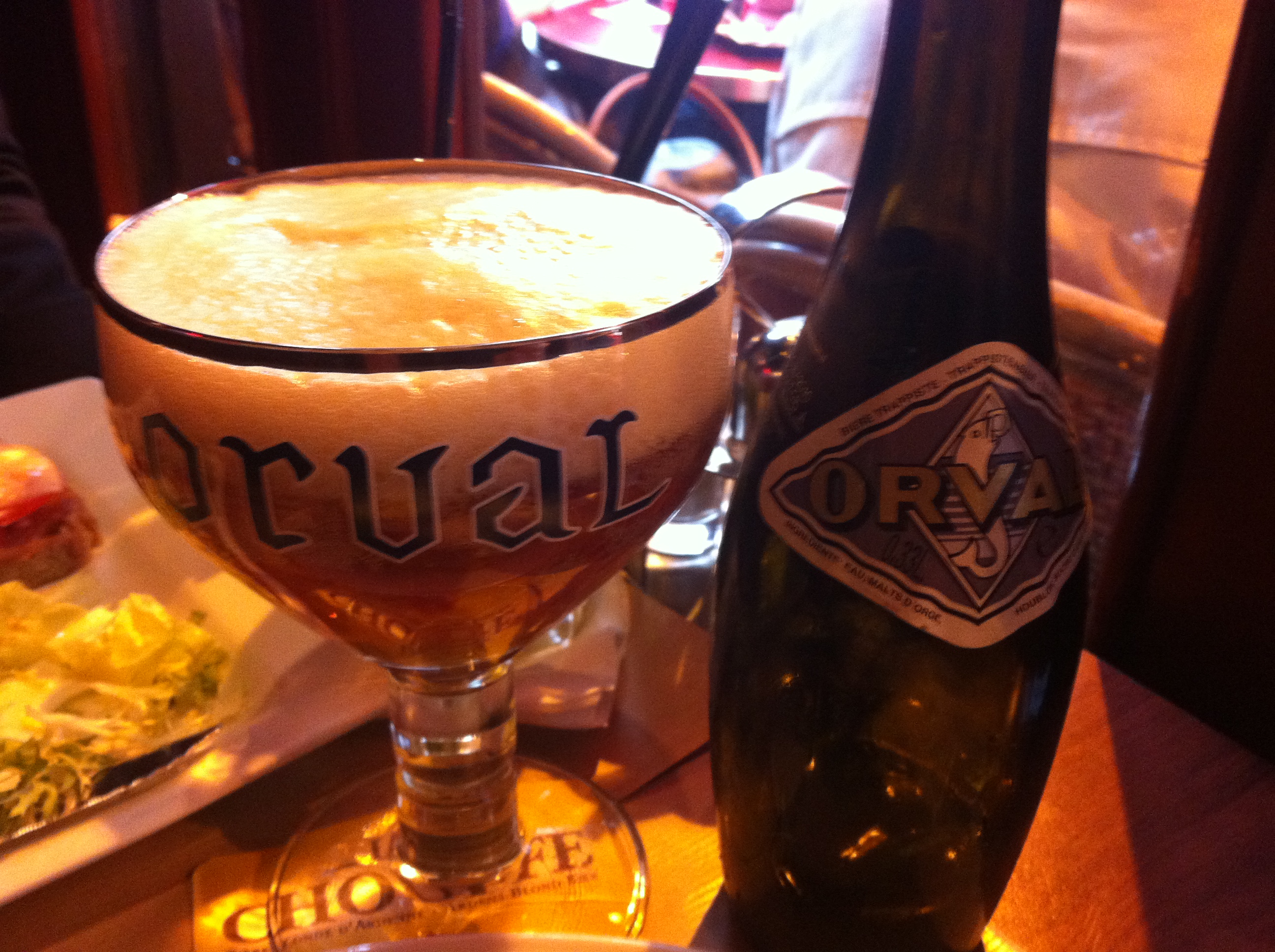
There weren’t any more interesting French beers on offer, so I stuck with the refreshing theme and opted for a bottle of Orval, the classic Trappist/wild ale. I’ve had both good and bad Orval (with the bad being so wild/funky that I find it nearly undrinkable), but this was a very good one: bright and thirst-quenching, certainly Bretty but not too much so, with just enough of a hoppy bite.

Orval

That reminds me that I noticed a couple of different places on this trip had two different listings of Orval on their menu: standard Orval, and Orval that was at least 6 months old. I was tempted by the latter, to see what kind of tricks the yeast plays when it’s had some time to age, but I never got around to ordering it. I’ll put it near the top of my list for the next trip.

The next day, we took a break from our sightseeing to get a couple of drinks at Le Sous-Bock, another beer-friendly restaurant/bar, this one in the 1st district, east of the Louvre. Their beer menu was long but relatively uninspiring, with plenty of basic European macro-lagers and even Budweiser (the US one) and Corona.

The one interesting thing on the French page was Oldarki (Biere au Patxaran), a beer from the French Basque country brewed with Patxaran, the traditional Basque plum liqueur. I’ve had Patxaran many times (my family’s Spanish roots include some Basque strains) and it’s quite tasty.

Sadly, this beer wasn’t. It tasted like any number of beers out there that have some sort of artificial additive mixed in with a mediocre base beer. It wasn’t undrinkable, just uninteresting and relatively unappealing. Seemed like a waste of a decent idea. Then again, there are plenty of great beers that feature really nice plum flavors, without having to resort to any post-brewing additions.

Oldarki 1

Oldarki 2

After that letdown, I opted to go back to a reliable favorite: St. Bernardus Abt 12, a classic quad and one of my favorites. It quickly and emphatically washed away the previous beer.

St. Bernardus Abt 12

Honeymoon beers, part 7: Amsterdam, De Beiaard, ‘t Arendsnest, De Molen

After a very long day of touristing around Amsterdam, I was happy to find that the restaurant we hit for dinner, Humphrey’s, had a beer I had never drank, Leffe Bruin, on draft. For a decidedly un-beery restaurant, it was a nice surprise, a tasty Belgian brown that went down very easily with a big, hearty meal.

Leffe Bruin

The following day, we took a break from more serious touristing for a quick lunch-and-beer at De Beiaard in the Spui square. De Beiaard is a chain of restaurant/bars, with this location perfectly situated between a busy square and one of the canals, making it a great people-watching spot as tourists and locals streamed by on foot, bicycle, scooter, tram, car and boat.

Their beer selection was decent, and one thing caught my eye, Hertog Jan Grand Prestige, a quad. I’m a sucker for quads, even ones I’ve never heard of or tried. It’s not necessarily the ideal style for a lunch beer, but I enjoyed it. We were also glad that we were practically on our way out when we noticed a small mouse dashing under a table across the room. That was our cue to leave.

Hertog Jan Grand Prestige 1

Hertog Jan Grand Prestige 2

That night, our final one in Amsterdam, we walked the half-dozen blocks from our hotel to ’t Arendsnest, a very well-regarded bar that prides itself on serving only Dutch beer, and a wide range of it. I came prepared with RateBeer.com’s list of top 50 Dutch beers, and was both thrilled and disappointed to see that the bar had many of them. Thrilled, of course, because I would be able to drink a couple of them, but also disappointed because I knew I couldn’t spend another week or two hanging out there and tasting a bunch more.

Despite the wide range of options, I ended up with two beers from De Molen, a brewery which practically owns the top of that list of great Dutch beers, and which seems to have fully embraced the idea of big and bold beers. I ended up drinking two of their beers, both big and delicious imperial stouts.

The first was De Molen Hel & Verdoemenis, which means Hell and Damnation. It was relatively fresh, bottled 9/16/10 (bottle #785, incidentally), and you could tell. Even though I really liked it, in all its thick, black, motor-oil glory, it was also very big and boozy (10% but tasted bigger). You could tell that a few years would help turn it from a very good beer to a great one.

De Molen Hel & Verdoemenis 1

De Molen Hel & Verdoemenis 2

I followed that up in the only way I could, with another huge stout: De Molen Hemel & Aarde (which means Heaven & Earth). The standard version is a 9.5% imperial stout which the brewery says is “made with the most heavily peated malt in the world from the Bruichladdich distillery”. Well, I didn’t drink the standard version. Instead, I ordered an aged version. Here’s the brewery’s description:

“And still we thought that we could do better! So we barrel aged this beer in Bruichladdich whisky barrels used for the first time in 1972. As a result an unbelievable complex beer with flavours like smoke, vanilla, coffee, chocolate, peat and wood. What’s not there? And the most surprising part is probably the great balance between these flavours. This is why it’s still very easy drinkable. But it’s no beer for those who are just discovering real beers.”

The aging boosts the abv up a tad, to 10%, but it tastes much bigger than that. Bottled on 6/7/10 (bottle #919), this has to go down as the peatiest imperial stout I’ve ever drank. I’m not a Scotch nerd, and on the rare occasions when I do drink Scotch, I think I prefer it less peaty. Still, this beer was delicious. The huge wave of peat up front quickly settled down, so that instead of overwhelming the beer it just led the way to tons of big stout goodness: vanilla, chocolate, smoke, all in a thick, mouth-coating package. It came in a small bottle, just 20cl (I think), which seemed the perfect size to slowly sip this monster. It screamed “cigar beer”, and I don’t smoke cigars at all.

De Molen Hemel & Aarde Bruichladdich Barrel 1

De Molen Hemel & Aarde Bruichladdich Barrel 2

A quick note about the bartender: he was nice and was working hard, but he was also quite clueless, which was disappointing for such a well-regarded beer bar. Both times that I ordered, he pulled out the wrong bottle from the coolers. Fortunately, he showed me the bottles before opening them, so I had a chance to correct him both times.

Also, before ordering the second stout, I tried to order off the vintage menu, which listed (among other very tempting things) 2003, 2004 & 2006 vintages of La Trappe Quadrupel. I asked for the 2003, and he pulled out a fresh bottle instead. I pointed to the vintage section in the menu, but he said they didn’t have any of those beers. I suspected that he just didn’t know where they were, but even if they were simply out of stock, it was disappointing. In the end, though, this was a relatively small annoyance at an otherwise great bar.

Sadly that was the end of our time in Amsterdam, with an early wake-up call and long day of train travel to Paris the next morning. What a way to go out, though. The next time I’m in Amsterdam, I’m going directly to ‘t Arendsnest, and I’ll make sure to have done much more research on Dutch craft beer.

Honeymoon beers, part 6: Amsterdam, In de Wildeman

Our next stop was Amsterdam. I’m not nearly as familiar with Dutch beer as I am with Belgian beer, so I was very excited about encountering a beer culture with a history of brewing great, traditional styles, but which also seems to be embracing much of the interesting, creative stuff at the forefront of the craft beer boom.

Our hotel happened to be 4 doors down from one of the more respected beer bars in town, Bierproeflokaal In de Wildeman. It was an obvious first stop.

“Proeflokaal” means “tasting room”. In de Wildeman, despite being right in the middle of the bustling nightlife scene in the heart of Amsterdam, seemed very much a locals place. When we walked in on a Monday night, there was a smallish, older crowd tucked into the small table areas, and a couple of people standing at the low bar. It sounds funny, but that’s how it works – the bar is low, maybe waist-high, with no bar stools or seats, so people stand there and hang out.

I didn’t know what to target here, and their wide selection (with a chalkboard listing ~25 seasonals and rarities) gave me a ton from which to choose. I finally opted for a 2009 Kasteel Cuvee de Chateau on draft, a dark Belgian ale with a thick creamy head and nice boozy kick.

Kasteel Cuvee de Chateau

For my next beer, I asked the bartender for suggestions, and he pointed out the Flying Dog 25th Anniversary Farmhouse IPA. At first I worried that it might be a different name for the Raging Bitch Belgian-style IPA, which is a very good beer but which was also readily available in Houston. But the bartender assured me that it was a beer that Flying Dog brewed specifically for the bar’s anniversary. That certainly made it worthy, and I’m glad I drank it. It was the only saison-style beer that I had on the trip, and also the only hoppy IPA that I drank, making it a very nice, refreshing departure, with the added bonus that it was a well-done, interesting blend of the two styles.

Flying Dog / In de Wildeman 25th Anniversary Farmhouse IPA

With Mrs. Beernerds still working on her sweet lambic, I ordered a third beer: De Ranke XX Bitter. I had heard good things about it, and I very nearly ordered it at Chez Moeder Lambic in Brussels, before the waiter recommended a different offering from the same brewery, the Noir de Dottignies. It made sense here, as a follow-up to a hoppy saison, and it held up very nicely. It seemed like an interesting mix between a classic English ESB and a hoppy American pale ale, with just a touch of Belgian yeast to round it out.

It was the third and final De Ranke beer that I drank on the trip, and I must say that the brewery really impressed me. We don’t get their stuff in Texas, and I’m not sure we get it in the US, but it’s well worth seeking out.

De Ranke XX Bitter

Next Page »


BeerNerds on Twitter

Archives


Follow

Get every new post delivered to your Inbox.